Showing posts with label Avantgarde. Show all posts

Sunday, July 17, 2011

7/17 Beethoven's Symphonies and Overtures for Guitarists and Experimental Music Lovers

Picasso, "Woman with Mandolin" 1910
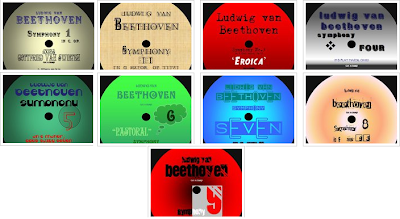
The symphonies of Beethoven are to me the greatest artistic creation in the history of mankind.  So of course it's pretty ambitious to transcribe these for rock instruments.  I resisted for a long while, but once I figured out a way to do the concertos, it was a natural next step.  The first couple symphonies took to a new instrumental arrangement relatively painlessly, but then things started getting sticky.  By the time I got to the 8th, the whole thing started sounding like avant-garde music from the future!  Taming the 9th was a journey in itself.  Nonetheless, here's the fruits of those labors, and I'm sure I'll come back to these again and again with "improvements"....

Symphony No.3 in E flat major, Op.55 'Eroica' (1805)


Symphony No.7 in A major, Op.92 (1811)


Click for the 9 Symphonies of Beethoven for Rock and Roll Addicts

Overtures here:

Saturday, July 16, 2011

7/16 The Compleat String Quartets for Guitarists and Experimental Music Lovers

I've posted about my sequenced "rock" transcriptions of Beethoven's string quartets a couple times before but this time I've gone back and remixed/remastered them a bit, with some simulated "turntable" visuals.  Basically I added more drums, reverb and compression.  They'll probably still drive any purists insane with cries of sacrilege, but for anybody with a background in rock and avant-garde music approaching my own, these might be entertaining and perhaps even illuminating.

While arranging/transcribing Beethoven's various types of music (quartets, concertos, symphonies, etc...) into these somewhat similar rock arrangements, I could more clearly see the different composing approaches he used between these genres.  The concertos seem the most straightforward from a melodic and structural standpoint, though the solo part gets all the "adventurous" stuff.  The quartets have the most complex and labyrinthine horizontal/melodic material, and the symphonies take a middle ground of having dense vertical constructions but simpler thematic material.  These are just gross generalizations of course...

String Quartet 10 in Eb, Op 74 "Harp" (1809)


String Quartet 11 in Fm, Op.95 "Serioso" (1811)


Full Quartets Below:
Early Quartets: Opus 18
Middle Quartets: Opus 59, 74, 95

Late Quartets: Opus 127, 130, 131, 132, 133, 135

Symphonies tomorrow....

Friday, July 15, 2011

7/15 The Weirdest Piano Concerto Arrangements You'll Love Vol.2

Remember when I posted the "The Weirdest Piano Concerto Arrangements You'll Love Vol.1"? Well here's Volume 2...hope you enjoy listening, these were a blast to put together!

Piano Concerto 1
I: 0:04 II: 12:29 III: 20:32

Link

Piano Concerto 2
I: 0:05 II: 13:15 III: 20:36

Link

Piano Concerto 4
I: 0:04 II: 16:44 III: 20:20

Link

Triple Concerto

Link

Next post is going to be delayed because I'm just BARELY keeping up in these last few mega-posts and Youtube just yanked my unlimited time-limit video rights for no apparent reason - which means I may have to redo a whole lot of already completed videos. Sad face.

Friday, July 8, 2011

7/8 Clockwork and a Calendar

From a "Beethoven Calendar"
Remix time...
Marc Heatley: Created as part of Sound Affairs' 2008 "Ludwig" tour - "A tribute to Beethoven in music and film."  I was asked to create original work in response to the music. This piece (to accompany the Orlando Gough composition "Dead White European Male") is based on David Pelham's iconic 1972 Penguin cover to the Anthony Burgess' classic "A Clockwork Orange".
"Dead White European Male" (Symphony 7 Allegretto remix)

Link


Coriolan Overture (Dance Style)
(wykonanie Krashgul)

Link

If 1907 comes around again this will be handy:

A Beethoven Kalendar from 1907...

Tuesday, June 21, 2011

6/21 The Weirdest Piano Concerto Arrangements You'll Love Vol.1

“Guitar” (1914) ferrous sheet metal and wire" MoMA © 2011 Estate of Pablo Picasso
The Weirdest Piano Concerto Arrangements You'll Love Vol.1...or perhaps can "Like Eventually"...

After doing rock versions of Beethoven's complete string quartets, I decided that I wanted to hear how his concertos might sound if the lead instrument were a guitar instead of a piano or violin (or cello).  After a few fruitless attempts at incorporation guitar sounds into symphonic arrangements, I tried to do a guitar and synthesizer version.  Despite a good amount of work I finally had to admit that it just didn't sound that good.  Finally I realized that I should go back to my previous idea with the quartets and make full rock band arrangements for these works.  It took a bit more work since I didn't want to lose a single note, but I managed to get everything down to 2 electric guitars, bass and organ (as well as the lead instrument).

Here's Beethoven's Violin Concerto in a "Rock" arrangement.  Electric guitar replaces the violin solo, as well as the 1st violin part.
1 Allegro ma non troppo: from 0:03
2 Larghetto: from 22:03
3 Rondo. Allegro: from 29:18
Guitar Arrangement sequenced by Ed Chang using Synthfont.

Link

And here's Beethoven's 3rd Piano Concerto in a similar arrangement, with acoustic guitar as the soloist and electric guitars in the 1st and 2nd violin roles...
1. Allegro con brio: from 0:03
2. Largo: from 14:24
3. Rondo-Allegro: from 21:49
Guitar Arrangement sequenced by Ed Chang using Synthfont.

Link

Piano Concerto 5...the piano solo is divided into Left Hand -> Acoustic, Right Hand -> Electric
I: 0:03    II: 18:44   III: 25:15

Link

I did arrangements for all of B.'s concertos so I'll put up some more soon....

Wednesday, June 1, 2011

6/1 Röder's Electro-Acoustic Beethoven Cadenza

As someone with a background in electro-acoustic music, I was quite excited to hear about this project: pianist Seda Röder performs an original piano-&-electronics cadenza as part of a performance of Beethoven's Emperor Concerto. I have to admit I was a bit skeptical that it could work - but I can honestly say Ms. Röder pulled it off beautifully!  The trill going into the "modern" section was a stroke of brilliance.

From the video description:
In this video, New Music Pianist Seda Röder improvises the first-ever electro-acoustic cadenza for a classical concerto! Röder, who specializes on bringing contemporary music to new audiences, says that "the public at Beethoven's time would expect the soloist to improvise in the cadenzas. I wanted to do the same, but in a style that is my own and entirely modern." To turn this vision into reality, Seda worked together with Mexican composer Edgar Barroso who provided her with an electro-acoustic framework that she could use for her improvisations. When Röder was approached by Harvard conductor Hanjay Wang with the suggestion to perform with the orchestra of the Harvard-Radcliffe Chinese Students Association, the unusual idea finally came to life!  Please visit the artist's website to find out more about this very special project: http://www.sedaroeder.com/blackbox-011/
Seda Röder improvizes first-ever electro-acoustic cadenza for a classical concerto
Piano Concerto 5 Cadenza by Seda Röder and Edgar Barroso

Link

Friday, May 27, 2011

5/27 Timpani of the 9th / Slow Elise

Oliver at Timpani
Beethoven was a big fan of timpani and basically set the timpani world on fire with his use of them in his symphonies. No previous symphonies and concertos had utilized timpani as such an integral part of the larger form of the work. In fact the Violin Concerto in D has a timpani intro motif which echoes throughout the remainder of the first movement. The 9th Symphony however, holds my favorite timpani part of all time - the incredibly long roll in the beginning of the recap of the 1st movement. In the famous Furtwangler recording of 1942 this section fairly explodes out of the speakers.

It's just as interesting to hear this part solo (unaccompanied), and thanks to these videos (auditions?) we can hear just how rich the sounds can be.  Also it's easier to see how different interpretations can create different sound fields...

Percussionist :

Link

Percussionist Fernanda Kremer:

Link

Since today has a kind of "droney" vibe, perhaps there's no better day than today to hear "Fur Elise" 800% S-L-O-W-E-R than normal (created using "Paul's Stretch" software):

Link

Friday, May 13, 2011

5/13 Beethoven on Baritone Garbage Truck

Today featuring a mixed bag of multi-disciplinary approaches to Beethoven...and I mean multi-disciplinary...

Lydia Koniordou recites extracts from the poem of Yiannis Ritsos "Moonlight Sonata" in Greek.

Lydia Koniordou recites "Moonlight Sonata" a poem by Yiannis Ritsos

Old HP scanner is happy and sings the Ode to Joy.

Scanner plays Beethoven

Garbage Truck in Taiwan: Fur Elise - (Turn down the volume, this is a bit LOUD!)

Kaohsiung - garbage truck

Finally, there's always the pop version of the 7th Symphony Allegretto 2nd movement with Karaoke recorder visuals.

Allegretto (7e symphonie) - Beethoven (flûte à bec)

Friday, April 1, 2011

4/1 Squeezed, Stretched and Webernized Beethoven

Well, being that today is April Fool's Day, I feel somewhat less inhibited than normal to post some of my more outlandish Beethoven "experiments"...

Last week, while working on my exotic percussion version of the 32 Variations in C minor WoO.80, I accidentally mapped the midi pitch data from the drum tracks to the guitar track, and when I replayed the sound file I thought...hmmmm, very "Webernian". Anyways, beyond the technical stuff, this is not "12-tone" in any way that is on purpose - it's just a bit of "chance-generated" fun and I'm pretty sure it would fool my mother if I told her it was by Webern...
An Atonal Variation on Beethoven's 32 Variations on an Original Theme
(Acoustic Guitar and Percussion Soundfonts)
Visuals by Malinowsky MAM Player

If Beethoven was Reborn as Webern

Another little oddity I put together is this ridiculously sped up version of the Moonlight Sonata.  I actually prefer the Moonlight Sonata to be played as slowly as possible, but increasing the speed to 1500 beats per minute and changing the sound to "guitar harmonics" yields something that might have come from the episode of Star Trek where the aliens were living at super-fast speed.
Moonlight Sonata at 1500 BPM on Guitar

Moonlight Sonata at 1500 BPM on Guitar

On the other end of the "time" spectrum is this version of the 9th Symphony.  A composer decided to digitally stretch out the 9th Symphony to the length of 24 hours.  The pitches all remain the same - but the durations of each note are lengthened proportionately so that the entire work (normally 75 minutes) is stretched to 24 hours. Here's a sampling, uploaded to Youtube by YT-er .

Duckieforever says: "The music is astounding, and ethreal, and beautiful. I just can't really say it any other way besides that. It's not like anything that I've ever heard in my life. But, for once, I think that after hearing the music rendered this way, I understand it more completly. It may not be what any of you enjoy, but I just ask that you open your minds, take a small breath, and relax."

A Total Beethoven Experience

For more on this work and accounts from attendees of a "performance" of this 24 hour version, check out the below link where you can find a Radiolab Radio podcast about it. (Direct mp3 link HERE)
Time - Radiolab

Sunday, March 27, 2011

3/27 Glenn Gould, Concert Dropout

For some reason I really enjoy listening to Glenn Gould talk - probably even more than listening to him play!  ...Then again I'd rather listen to his Beethoven piano sonatas again before re-hearing one of his "interviews" - no longevity is apparently the problem.

This recent discovery on YT was a fun listen though, "Glenn Gould: Concert Dropout".

From the cover it says:
Partial Agenda:
The Concert is Dead
The Only Excuse for Recording is to Do it Differently
The Great Get-Sibelius Plot Exposed
A Live Audience is a Great Liability
Petula Clark's Songs are in the Post-Mendelssohn Tradition
Why I Sing Along
Electronic Music is the Future

Apparently this was a largely scripted and edited affair - but it still answers a great many questions about Gould's later view on life and music.

This record is followed by "At Home with Glenn Gould" which was recorded while Gould was still playing live concerts - maybe this one was "real" since I found it far less interesting...
Pt 1-6: Glenn Gould: Concert Dropout (54 min)
Pt 7-15: At Home with Glenn Gould (1 hr 17 min)

Linklist

And here we have an excerpt of Glenn Gould performing to "no one" and re-interpreting Liszt reinterpreting Beethoven's Pastoral Symohony - this seems to encapsulate everything Gould talks about in the interview, right?

Friday, March 25, 2011

3/25 Beethoven on Exotic Percussion Instruments

African Slider Guiro - Ghana Shaker

Beethoven never visited the African continent or any other truly exotic tourist destinations in his lifetime, so he probably never heard any indigenous folk music from Egypt or India for example.  But if he had, I wonder if he would have incorporated some of these instruments into his work?  Since he was a big proponent of music technology and the first to use percussion as a primary motivic element (timpani in many symphonies/concertos and the "Turkish" interlude in the 9th Finale), I'm sure of it.  However, what I'm presenting today is probably nothing like what he might have composed.  It's still "from" Beethoven tho (in a sense).

I took a midi file of Beethoven's 32 Variations in C minor WoO.80 (1806) and mapped the notes to a soundfont comprised of exotic percussion samples. Though the pitches are no longer Beethoven's, the rhythms, dynamics and phrasing are still his. Still "classical music"?  Either way - I thought this came out pretty good...or at least fascinating.  (Visuals by Malinowsky MAM Player.)


Next, I took a midi file of Beethoven's "24 Variations on Righini's aria 'Venni Amore', WoO.65" (1791)
and arranged it for "junkyard percussion".  These are sounds recorded from pots, pans, powertools, and stuff you might find in a junkyard....the nature of these variation pieces lend themselves well to rhythmic transformations, I think.  By the way, these variations were originally dedicated to Countess Maria Anna Hortensia von Hatzfeld.  Somehow "The Hatzfeld Variations" has a nice ring to it.


These "arrangements" were alot of fun to create - I just hope this won't be known as the post where the Daily Beethoven "jumped the shark".
:)

Tuesday, March 15, 2011

3/15 Avant Garde, Meet Beethoven (reprise)

Warhole'd Warhol
For listeners of the "classical" repertoire, the work produced by the avant-garde composers of the post-war years can seem downright alien.  People like Pierre Henry and Karlheinz Stockhausen (among others) created a style of music which may seem to have more to do with movie sound effects than orchestral sonorities.  Yet most of these "noise" composers were huge fans of Beethoven from their earliest years...
(I covered Stockhausen and Mauricia Kagel's contributions to Beethoven ephemera HERE).

Luc Ferrari, who likes to juxtapose natural environmental sounds with noise/sound effects, said in a relatively recent interview in Paris TransAtlantic that, were he imprisoned in his studio for the rest of his life, he'd request to have Beethoven's Opus 106 remain with him (the Hammerklavier piano sonata).
Here's Luc Ferrari's "Strathoven": (the title will become self-explanatory...)


Gyorgy Ligeti also loved Beethoven, at least as a child. Speaking about how he learned to compose: "I had a kind of game which I played. Going to school took less than twenty minutes on foot and I always imagined... it was some Beethoven symphony or Schumann... what I heard from the radio and... of course, Beethoven was the centre. And, I always imagined I listened to a concert, I imagined this music naively and I heard it. And from this kind of listening to inner fantasy, which were not original, which were full with influence"
Here are 2 pieces by Ligeti, one a piano piece which sounds like it might have had its seeds sown from listening to early Beethoven piano sonatas, and another work which is probably closer to "sound effects" than anything using sonata-allegro form... 
Musica Ricercata III (Béla Bartók in memoriam)(1953):

Artikulation (1958):


Pierre Henry is another composer who works almost exclusively in musique concrete and electronically generated sounds.   He wrote quite alot about Beethoven in the liner notes to his homage and "remix" of Beethoven's "10th" symphony... I previously posted the liner notes HERE.
I decided to make a little visual accompaniment to the samples off of Amazon's page:


Finally, Helmut Lachenmann, another very modern composer (who at least one blogger thinks could be today's Beethoven), spoke about how he hears Beethoven "afire with his energies as a composer" during the Eroica Funeral March... He also composed "Staub" (1987) which is supposedly based on Beethoven's 9th symphony and is designed to precede a performance of the 9th. No video to be found, sorry...
Here's "Gran Torso", probably his most famous string quartet work.  Tho very interesting, I think it's safe to say it wasn't derived from a Beethoven work.

Friday, March 11, 2011

3/11 The Moonlight Sonata on Theremin / Marilyn Monroe Prefers Beethoven

(Clara Rockmore with Theremin)
Beethoven on the theremin - that's something you don't hear very often.  Most people have probably heard the sound of a theremin in sci-fi movies (Bernard Herrmann used FOUR in "The Day the Earth Stood Still") but the theremin is actually an instrument which was first considered a "classical" instrument.  Here's a fascinating theremin concert by Youtuber Thomas Grillo, including 2 works by LvB. The Beethoven pieces can be found at these times if you want to jump straight in:
17:58 Minuet in G (WoO.10, N2)
20:43 Moonlight Sonata
"Enjoy a half hour of Classical works played by Thomas Grillo on the Burns B3 Deluxe theremin with accompaniment generousely provided by Kristian Banatzianou of www.PianoAccompaniments.com and Peter Nagy."

Link

Additionally, here's the 2nd movement from the Pathetique Sonata on theremin performed by :

Link

Even tho I'd just recently posted a color analysis of Opus 130, here's a fun tribute/mash-up of the final movement with Marilyn Monroe in "Gentlemen Prefer Blondes" - just as colorful, but in a different way...
String Quartet No. 13 In B Flat Major, Op.130:VI. Allegro

Beethoven vs Monroe
Apparently Beethoven works with everything from the "King's Speech" to the "Glamour Icon's Dance"...somewhat.

Monday, February 28, 2011

2/28 A Turkish March for 16 Hands

Keyboards piled up at the Pearl River Piano factory (BBC)
Marches are good fun, at least musically.  Beethoven hated war of course, and his feelings about Napoleon are no secret, but he still composed quite a few marches, and one of them I covered here before.   While writing about the Liszt piano transcriptions last week, I was reminded of Beethoven's own variations of the Turkish March from his "Ruins of Athens" stage work. 

6 Variations in D major op.76 "Turkish March" (1809)
Sviatoslav Richter (Live 50's)

Sviatoslav Richter plays Beethoven Six Variations, Op. 76

But wait, what if Beethoven had 8 pianists at his house one day, all wanting to show him their performance of the Turkish March, but Ludwig only had 5 minutes?  Maybe it would sound something like this:
Turkish March from "Die Ruinen von Athen" (arr. for 8 pianos, Richard Blackford)
Piano: Gina Bachauer
Piano: Jorge Bolet
Piano: Jeanne-Marie Darré
Piano: Alicia De Larrocha
Piano: John Lill
Piano: Radu Lupu
Piano: Garrick Ohlsson
Piano: Bàlint Vàzsonzyi
Live recording, London - 1974
It gets interesting after the 2:24 mark...(note that I tagged this post with the "avant-garde" label)

Beethoven Turkish March (arranged for eight pianos)

There also happens to be a Turkish March in the finale of the 9th Symphony and probably some other works I can't recall right now... Robert Greenberg claims that "Turkish Marches" had more to do with exotic harmonies and melodies in any form, rather than melodies of a specifically Turkish nature. Frankly I don't know enough about the music of Hungary in the 1800's to agree with Prof. Greenberg or not, but I can see that easily being the case. It doesn't sound anything like Bartok tho...or does it?

Béla Bartók - Allegro Barbaro

Friday, February 18, 2011

2/18 Moonlight Milk Sonata / Toy Piano / 100 Days Revisited

Artist Sara Naim did a fascinating experiment with photographing milk at high speed while playing Beethoven's Moonlight Sonata through the milk - resulting in these vibratory snapshots.  Some really cool pictures and a very unique way of visually representing the abstract narrative of a piano sonata. 
From Sara Naim's website:
Beethoven - Moonlight Sonata: "This body of work looks at translating sound into a photographic image. Ludwig Van Beethoven’s sonata vibrates through milk. He composed this piece in the early 1800’s for his blind pupil and lover, Giuletta Gucciardi. Gucciardi said to Beethoven that she wished she could see the moonlight. Beethoven then composed a piece about the moonlight’s reflection off Austria’s Lake Lucerne, called Moonlight Sonata."

The stuff about Lake Lucerne and Giuletta Gucciardi is not exactly corroborated by recorded facts, but it's a nice thought I guess...anyways the images are the thing.
Another unique take on the Moonlight Sonata is this performance adapted for "Toy Piano" by specialist Margaret Leng Tan. I'm actually more familiar with Ms Tan's work as a performer of John Cage's works, so this is quite surprising and a little odd. What's even odder is that Cage hated Beethoven - one assumes John Cage is rolling in his grave ;)


There are boatloads of videos of the Moonlight played on acoustic and electric guitar and most of them are well...frankly, not particularly interesting, but this one by Michael Lucarelli stands out as a fine transcription in its own right (and a fine video production as well):


If you're interested in hearing what the Moonlight Sonata sounds like on electric guitar after it's been sped up to 1500 bpm (from its original tempo of 40 bpm)...click below...

Beethoven - Moonlight Sonata at 1500 BPM on Guitar

It's pretty out there ;)

Finally, to round out a light Friday post, here's an update to an older post where I mentioned Jessica Svendsen's 100 Days Project - she's DONE! 
From Ms. Svendsen's website: "Every day for 100 days, I created a variation on a Josef Müller-Brockmann poster for a Beethoven concert in Zürich in 1955. This project was part of the Michael Bierut 100 Days Workshop at the Yale School of Art."

I really liked her designs, so much so that I threw them into my video editing software and generated a quick video using the Coriolan Overture (conducted by Dmitri Mitropoulos).  The poster itself is for a Coriolan Overture performance by Carl Schuricht, but I don't have that particular one handy, oh well....

100 Days Website

Friday, February 4, 2011

2/4 Grayson's Bartok's Beethoven's Moonlight Impression

I think for Fridays I'm going to start featuring interesting covers/arrangements of Beethoven works.  Their might be some humor involved.  I'll be doing my best to avoid easy listening versions of Fur Elise tho....

So today we have Professor Richard Grayson's improvisation on Beethoven's Moonlight Sonata in the style of Bela Bartok.  I actually featured Bartok playing the Kreutzer Violin Sonata with Szigeti a short while back, so this is perhaps a "rebuttal" of sorts....also this is a chance to add one more Bartok-factoid:  Pierre Boulez once remarked that Bartok "possessed a sense of form far closer to Beethoven than to Schoenberg."


Professor Grayson actually has a few Beethoven-themed videos on his Youtube channel but this one is by far my favorite.

(Top image from www.layoutsparks.com)

Friday, December 10, 2010

12/10 Beethoven's Journey Around the World

(The World in 1800)
Actually it's Urian's Journey Around the World.
One of the interesting songs Beethoven set to music in his early days was "Urians Reise um die Welt (Urian's voyage round the world)", the first song in the 8 Lieder Op.52 (1793?).  Around this time Beethoven had recently left Bonn to visit Vienna for the first time (1792), and soon undertook several concert tours through Prague, Dresden, Leipzig and Berlin (1796).  Perhaps these experiences motivated him to put such a "light" piece to music...or the other way around.

Basically the text is 14 refrains of "Urian" telling the story of his travels to the North Pole, Africa, China, America, Mexico, Tahiti, etc...and how everyone is as foolish as the people back home :).  When I first heard this song I thought it was kind of repetitive - until I read the translated text...a very big help to the enjoyment of this song!

Watch this video I threw together for the full text in German and English and have a sing-along..
..sorry if the text is a bit blurry - too many lyrics to type out!  Watch at 480p if you can.


text

Finally, everytime I hear about a music "journey around the world" I always flash back to my days as a Stockhausen fan and listening to his avant-garde opera "Licht".  He has a piece called Michael's Journey Around the World.  Is it possible he cribbed from Beethoven? Here's a blog with video..interesting stuff but not for the faint of heart...

Friday, October 29, 2010

10/29 When Schoenberg Taught Beethoven

My main reason for traveling through Vienna recently was to track down Beethoven's homes and haunts, but a nice diversion one day was a stop at the Arnold Schoenberg Center.  Schoenberg is famous for advocating the 12-tone system of composition (Liszt actually used a 12 note row in the Faust Symphony).  Basically all 12 notes of the chromatic scale are used in equal measure so as to prevent "traditional" tonal cliches.  It's not a strict rule as I understand it - it's a tool to be used to liberate the compositional process.  In succeeding years Schoenberg's ideas were taken to such extremes by his successors  that many of the results can sound more like random pitches rather than an organized composition.  Anyways, I like Schoenberg's music, but I don't love it, so I wasn't expecting to enjoy it all that much - it turned out to be one of the greatest museums I've ever seen devoted to a single person.  The exhibit was designed by his daughter and she gives a video introduction.  The first thing to see is a full reproduction of Schoenberg's study in his home in California.  It is jam-packed with musical detritus and features many inventions that Schoenberg made and never got famous for, including the first tape dispenser.

The next room is a concert video room where several excerpts of his works are played in a continuous 45 minute (?) loop.  After that is a clothesline with a collection of playbills and concert posters.  That leads to his "educational" exhibit which is about Schoenberg's teaching days in America.  It includes actual tests he gave out as well as course syllabi and replies to indignant critics.  I'll post just the "Beethoven-related" tests....I never guessed he taught LvB!
(Below are a student's test on Beethoven Opus 13 "Pathetique" and then a test on Beethoven Piano Sonata 5.)

The next table is a hands-on collection of Schoenberg's"stuff" - which includes his address book (where I found his hand-written entries for Kandinsky and Webern), his playing cards (which he designed himself), his photo album, and some sketchbooks.  This table alone had enough to keep the Schoenberg fan busy for an hour or more.  Nearby is some kind of Dictaphone which Schoenberg used to record some early interviews.  In another room is a collection of all of his compositions which you can photocopy for free at a nearby machine.  There's also a research library which I didn't go into.  From time to time they host concerts in a room above as well.  It's really quite a center and a very nice surprise. (click on the photos for enlargements).
Syllabus for his Beethoven class?

Sunday, October 17, 2010

10/17 The Große Fuge, the Grosser Fugue

Beethoven's Grosse Fugue is one of my all time favorites and I could probably spend a whole week talking about it, but since I'm currently travelling here's an interesting comparison between Beethoven's original string quartet version vs Wilhelm Furtwängler's orchestral arrangement.  I play Ludwig's original arrangement much more often - but the Furtwängler is no slouch!

Grosse Fuge, Op. 133 for String Quartet
Pt 1-2 Quartetto Italiano I think
Pt 3-4 Furtwängler's orchestral version
Pt 5-6 Winkler version for fortepiano
Pt 7 - pour a good stiff drink.

Tuesday, October 12, 2010

10/12 Pierre Henry's Beethoven


I have no idea what this 1979 homage sounds like, but his 2007 remix may give you some idea...(Pierre Henry in case you don't know is one of the fathers of "musique concrete", the making of musical sounds using electronic tape and collage effects).  Thanks to Doug Theriault for alerting me to the existence of this unusual homage.  More info here.
Update: More here:
3/15 Avant Garde, Meet Beethoven (reprise)