Showing posts with label Transcriptions-for Rock-Music-Lovers. Show all posts

Sunday, July 17, 2011

7/17 Beethoven's Symphonies and Overtures for Guitarists and Experimental Music Lovers

Picasso, "Woman with Mandolin" 1910
The symphonies of Beethoven are to me the greatest artistic creation in the history of mankind.  So of course it's pretty ambitious to transcribe these for rock instruments.  I resisted for a long while, but once I figured out a way to do the concertos, it was a natural next step.  The first couple symphonies took to a new instrumental arrangement relatively painlessly, but then things started getting sticky.  By the time I got to the 8th, the whole thing started sounding like avant-garde music from the future!  Taming the 9th was a journey in itself.  Nonetheless, here's the fruits of those labors, and I'm sure I'll come back to these again and again with "improvements"....

Symphony No.3 in E flat major, Op.55 'Eroica' (1805)


Symphony No.7 in A major, Op.92 (1811)


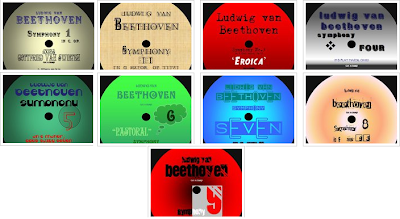
Click for the 9 Symphonies of Beethoven for Rock and Roll Addicts

Overtures here:

Saturday, July 16, 2011

7/16 The Compleat String Quartets for Guitarists and Experimental Music Lovers

I've posted about my sequenced "rock" transcriptions of Beethoven's string quartets a couple times before but this time I've gone back and remixed/remastered them a bit, with some simulated "turntable" visuals.  Basically I added more drums, reverb and compression.  They'll probably still drive any purists insane with cries of sacrilege, but for anybody with a background in rock and avant-garde music approaching my own, these might be entertaining and perhaps even illuminating.

While arranging/transcribing Beethoven's various types of music (quartets, concertos, symphonies, etc...) into these somewhat similar rock arrangements, I could more clearly see the different composing approaches he used between these genres.  The concertos seem the most straightforward from a melodic and structural standpoint, though the solo part gets all the "adventurous" stuff.  The quartets have the most complex and labyrinthine horizontal/melodic material, and the symphonies take a middle ground of having dense vertical constructions but simpler thematic material.  These are just gross generalizations of course...

String Quartet 10 in Eb, Op 74 "Harp" (1809)


String Quartet 11 in Fm, Op.95 "Serioso" (1811)


Full Quartets Below:
Early Quartets: Opus 18
Middle Quartets: Opus 59, 74, 95

Late Quartets: Opus 127, 130, 131, 132, 133, 135

Symphonies tomorrow....

Friday, July 15, 2011

7/15 The Weirdest Piano Concerto Arrangements You'll Love Vol.2

Remember when I posted the "The Weirdest Piano Concerto Arrangements You'll Love Vol.1"? Well here's Volume 2...hope you enjoy listening, these were a blast to put together!

Piano Concerto 1
I: 0:04 II: 12:29 III: 20:32

Link

Piano Concerto 2
I: 0:05 II: 13:15 III: 20:36

Link

Piano Concerto 4
I: 0:04 II: 16:44 III: 20:20

Link

Triple Concerto

Link

Next post is going to be delayed because I'm just BARELY keeping up in these last few mega-posts and Youtube just yanked my unlimited time-limit video rights for no apparent reason - which means I may have to redo a whole lot of already completed videos. Sad face.

Tuesday, June 21, 2011

6/21 The Weirdest Piano Concerto Arrangements You'll Love Vol.1

“Guitar” (1914) ferrous sheet metal and wire" MoMA © 2011 Estate of Pablo Picasso
The Weirdest Piano Concerto Arrangements You'll Love Vol.1...or perhaps can "Like Eventually"...

After doing rock versions of Beethoven's complete string quartets, I decided that I wanted to hear how his concertos might sound if the lead instrument were a guitar instead of a piano or violin (or cello).  After a few fruitless attempts at incorporation guitar sounds into symphonic arrangements, I tried to do a guitar and synthesizer version.  Despite a good amount of work I finally had to admit that it just didn't sound that good.  Finally I realized that I should go back to my previous idea with the quartets and make full rock band arrangements for these works.  It took a bit more work since I didn't want to lose a single note, but I managed to get everything down to 2 electric guitars, bass and organ (as well as the lead instrument).

Here's Beethoven's Violin Concerto in a "Rock" arrangement.  Electric guitar replaces the violin solo, as well as the 1st violin part.
1 Allegro ma non troppo: from 0:03
2 Larghetto: from 22:03
3 Rondo. Allegro: from 29:18
Guitar Arrangement sequenced by Ed Chang using Synthfont.

Link

And here's Beethoven's 3rd Piano Concerto in a similar arrangement, with acoustic guitar as the soloist and electric guitars in the 1st and 2nd violin roles...
1. Allegro con brio: from 0:03
2. Largo: from 14:24
3. Rondo-Allegro: from 21:49
Guitar Arrangement sequenced by Ed Chang using Synthfont.

Link

Piano Concerto 5...the piano solo is divided into Left Hand -> Acoustic, Right Hand -> Electric
I: 0:03    II: 18:44   III: 25:15

Link

I did arrangements for all of B.'s concertos so I'll put up some more soon....

Friday, June 17, 2011

6/17 All New Beethoven Guitar Hits!

There's nothing more educational (for me, at least) than to post about Beethoven every single day - but a close second would arranging his works for guitar.  Taking a close look at each and every measure and tweaking them to fit in the context, range and style of a guitar is a bit of work - but quite rewarding.  A couple of my recent "experiments" are these two transcriptions: an arrangement of B.'s Symphony 3 "Eroica" 1st Movement (adapted from Franz Liszt's transcription for solo piano) and the Diabelli Variations (using a new guitar sound than my 2 previous versions).  As with my other guitar arrangements these sequenced realizations would  probably be extremely difficult (if not impossible) to play in real life without special tunings, etc...but they sound still pretty cool I think as "virtual extrapolations"...

Symphony 3 "Eroica" for 2 Guitars

Link

The Diabelli Variations for 2 Guitars

Link
Left Side Guitar - TOP                     Right Side Guitar = BOTTOM 
0:04 - Tema : Vivace
0:52 - Variation 1 : Alla marcia maestoso
2:22 - Variation 2 : Poco allegro
3:22 - Variation 3 : L'istesso tempo
4:15 - Variation 4 : Un poco piu vivace
5:03 - Variation 5 : Allegro vivace
5:52 - Variation 6 : Allegro ma non troppo e serioso
7:24 - Variation 7 : Un poco piu allegro
8:40 - Variation 8 : Poco vivace
9:47 - Variation 9 : Allegro pesante e risoluto
11:25 - Variation 10 : Presto
12:24 - Variation 11 : Allegretto
13:40 - Variation 12 : Un poco piu moto
14:45 - Variation 13 : Vivace
15:53 - Variation 14 : Grave e maestoso
19:46 - Variation 15 : Presto scherzando
20:34 - Variation 16 : Allegro
21:39 - Variation 17 : Allegro
22:45 - Variation 18 : Poco moderato
25:10 - Variation 19 : Presto
26:07 - Variation 20 : Andante
27:32 - Variation 21 : Allegro con brio - Meno allegro
28:50 - Variation 22 : Allegro molto ( alla 'Notte e giorno faticar' di Mozart)
29:36 - Variation 23 : Allegro assai
30:25 - Variation 24 : Fughetta ( Andante)
32:52 - Variation 25 : Allegro
33:37 - Variation 26 : Piacevole
34:21 - Variation 27 : Vivace
35:09 - Variation 28 : Allegro
36:11 - Variation 29 : Adagio ma non troppo
37:19 - Variation 30 : Andante, sempre cantabile
38:49 - Variation 31 : Largo, molto espressivo
42:28 - Variation 32 : Fuga (Allegro)
46:07 - Variation 33 : Tempo di minuetto moderato


This is my 3rd try at making a Diabelli Variations guitar recording, I think it's the final version...the previous two are OK but this one has the best guitar sound I think.  Previous versions:

Electric and Acoustic guitars: http://www.youtube.com/watch?v=o0RyJF5Uavo
Acoustic Guitars (1st version): http://www.youtube.com/watch?v=ZTg1GWIiX7w


However, for a live rendition of an arrangement of B.'s 5th Symphony I think this is the guy to beat:
Warning - very loud recording...

Beethoven 「運命」 LUNA KENZO

Thursday, March 10, 2011

3/10 String Quartet Op.133 "Grosse Fuge" (Color Analysis and Rock Arr.)

Yesterday was the color chart/video of Opus 130, and since the Grosse Fugue was originally the grand finale of Opus 130 it seems necessary to put up Mr. Rich's color breakdown of this crazy and fun behemoth.  I think this is like the 2nd or 3rd analysis of the G.F. I've posted, but this one is pretty much all from Alan Rich's book, "Play by Play".  Personally I like my own analysis better, his is a little too simplified for my tastes, but I learned alot from his....

String Quartet Op.133 "Grosse Fuge" (1826)
Guarneri Quartet


Overture (MAROON)
1st Theme
2nd Theme
3rd Theme
4th Theme

Part I: fugue (based on 4th Theme): (BROWN)
Entrance 1
Entrance 2
Entrance 3
Entrance 4
Exposition (partial)
Variations on subject
Exposition (partial)
Exposition (variations on subject)

Part II: (BLUE)
3rd Theme (return)
3rd Theme (several fugue-like entrances)
3rd Theme (fragments)
3rd Theme (variation)

Part III: (VIOLET)
2nd Theme (return)
2nd Theme: fugue
2nd Theme: fugue (abridged)
2nd Theme (variation)
2nd Theme (further variation)

Part IV: (SEA GREEN)
3rd Theme (return)
Transition

Part V: (DARK BLUE)
2nd Theme (return)
2nd Theme (development)
1st Theme (return)

Part VI: fugue (based on part I) (OLIVE)
1st Theme (return)
Part I (variation)

(form breakdowns from Alan Rich's "Play by Play")

Rock Arrangement:

Wednesday, March 9, 2011

3/9 String Quartet Op.130 (Color Analysis and Rock Arr.)

Beethoven's String Quartet Opus 130 has the distinction of having had the "Grosse Fuge" as it's original ending, and then having that shortly replaced with a new final movement, which also happens to be B.'s last completed work.  For those reasons it's very much an "omega" work.  One thing that always amazes me about the new finale is that it's so joyful and "peppy".  At this time B. must have suspected that he wouldn't live much longer - he was trying to recover from a long-term illness during it's composition.  Also he was completely deaf, and his nephew Karl had just tried to commit suicide, blaming B. for driving him to such an extreme.  He was staying at his brother Johann's with whom he had had many rows, composing a work in response to public rejection of one of his most ambitious works.  It could not have been a happy time.  Nonetheless, the music of this "replacement movement" is vivacious.  I wonder if composing such contrary music was a method of self-therapy?  Let there be Light!

String Quartet Opus 130 (Final Version)
Guarneri Quartet
I. Adagio ma non troppo (0:00)
II. Presto (D♭) (13:40)
III. Andante con moto ma non troppo (B♭ minor) (15:36)
IV. Alla danza tedesca. Allegro assai (G) (23:01)
V. Cavatina. Adagio molto espressivo (E♭) (26:47)
VI. Finale. Allegro (33:50)


CHANNEL LINK (Click here to see this video on my YT Channel.  Once there, click on "(more info)" and then you can view the video in place, while scrolling through the text below)
I. Adagio ma non troppo/Allegro
--Exposition:
  • Introduction, part I (BROWN)
  • Introduction: part II
  • 1st Theme, part I (MAROON)
  • 1st Theme, part I (return)
  • 1st Theme, part II
  • 2nd Theme (DARK BLUE)
  • 2nd Theme: development
  • 3rd Theme (OLIVE)
--Exposition (Repeat):
  • Introduction, part I (LIGHT BROWN)
  • Introduction: part II
  • 1st Theme, part I (LIGHT MAROON)
  • 1st Theme, part I (return)
  • 1st Theme, part II
  • 2nd Theme (LIGHT BLUE)
  • 2nd Theme: development
  • 3rd Theme (LIGHT OLIVE)
--Development: 
  • First part: based on Introduction (VIOLET)
  • Second part: based on 1st Theme
--Recapitulation:
  • 1st Theme, part I (MAROON)
  • 1st Theme, part II (variation)
  • 2nd Theme (variation) (DARK BLUE)
  • 2nd Theme (return)
  • 3rd Theme (return)
  • Coda (VIOLET)

II. Presto (starting from 13:40)
  • A (GREEN)
  • B (BLUE)
  • Transition (PURPLE)
  • A (Return) (GREEN)

III. Andante con moto ma non troppo (starting from 15:36)
Exposition
  • Introduction (BROWN)
  • 1st Theme (MAROON)
  • Transition (OLIVE)
  • 2nd Theme (BLUE)
  • 1st Theme (Variation) (MAROON)
  • 3rd Theme (VIOLET)
Exposition Repeat
  • Introduction (LIGHT BROWN)
  • 1st Theme (LIGHT MAROON)
  • Transition (LIGHT OLIVE)
  • 2nd Theme (LIGHT BLUE)
  • 1st Theme (Variation) (LIGHT MAROON)
  • 3rd Theme (LIGHT VIOLET)
  • Coda (OLIVE)
  • 3rd Theme (VIOLET)
  • 3rd Theme: Development

IV. Alla danza tedesca: Allegro assai (starting from 23:01)
A: 
  • 1st Theme, part I (BLUE)
  • 1st Theme, part II (LIGHT BLUE)
B: 
  • 1st Theme (GREEN)
A:
  • 1st Theme, part I (BLUE)
  • 1st Theme, parts I and II (variation) (LIGHT BLUE)
  • 1st Theme, part I (BLUE)
  • 1st Theme, part I (fragmented variation) (LIGHT BLUE)

V. Cavatina: Adagio molto espressivo (starting from 26:47)
1st Theme, part I (GREEN)
1st Theme, part II
1st Theme (return)
2nd Theme (BLUE)
2nd Theme (return)
3rd Theme (VIOLET)
1st Theme, part I (return) (GREEN)
1st Theme, part II (return)

VI. Finale, Allegro (starting from 33:50)
Exposition
  • 1st Theme (MAROON)
  • 2nd Theme (BLUE)
  • 3rd Theme (GREEN)
Exposition Repeat
  • 1st Theme (repeat) (MAROON)
  • 2nd Theme (repeat) (BLUE)
  • 3rd Theme (repeat) (GREEN)
Development (PURPLE)

Recapitulation
  • 1st Theme (return) (LIGHT MAROON)
  • 2nd Theme (return) (LIGHT BLUE)
  • 3rd Theme (return) (LIGHT GREEN)
  • Development (return) (LIGHT PURPLE)
  • Coda (BROWN)
(form analysis from Alan Rich's "Play by Play")

And finally my sequenced "Rock" arrangement for those who like guitars, organ, bass and drums...if you're ambitious you could theoretically play both at the same time...maybe not.
 I. 0:04, II. 11:13, III. 13:17
IV. 19:00, V. 21:50,  VI. 29:01

Friday, March 4, 2011

3/4 "Learn to play Beethoven's 5th on Guitar" / Quartets V2

Beethoven seems to inspire many guitarists.  After piano, there are probably more amateur guitar performances of B.'s music than on any other solo instrument.  In fact, on Youtube there are over 7,000 videos featuring Beethoven's music on guitar...  I suspected that there might be alot but I was staggered to find the actual number.   Recently I came across a few ensemble guitar performances which stand out in some way I think....this batch concentrates specifically on the 5th Symphony.  Feel free to, uhh, skip to the next track if you feel the need  ;)

  • 1. Kid playing the 5th in a surf band (Takeshi "Terry" Terauchi Arr.)
  • 2. Drummer showcase of the 5th, probably my favorite of this genre
  • 3. Acoustic guitar orchestra arrangement of the 5th
  • 4. Salsa Arrangement by Sverre Indris Joner
  • 5. "Wave Invasion" surf medley using Fur Elise, 5th S, Ode to Joy
  • 6. Ruthie Bram's exuberant guitar solo to the 5th
  • 7. Taiko Game version (surprisingly entertaining)
  • 8. Symphony 6 "Pastoral" performed by "Sharp 5" (psych/pop version '71)
  • 9. Beethoven can save the Climate

Playlist

This seems like an appropriate post to mention that I re-uploaded my rock-sequenced arrangements of Beethoven's 17 string quartets of last year with MAM Player visualizations - here's the main text I wrote for each of these vids on Youtube...

String Quartets (Rock Arr. w MAM Visuals)
Guitar Arrangement by Ed Chang using Synthfont.
Visuals from Stephen Malinowski's MAM Player
Original MIDI sequences : www.stringquartets.org
Boilerplate: These tracks were originally created for my own use to understand Beethoven's string quartets. As an electric guitarist, I "hear" guitar and drums better than violin, so these helped me to follow the different melodic and harmonic turns that Beethoven used in these frankly still-revolutionary works. Weird syncopations and awkward double-stops and trills on violin sound even more exciting and shocking in today's musical vernacular IMHO, and when you add 'Chad Wackerman-style' drums doubling the bass melodies it gets pretty close to fusion/technical metal - tho the most complex metal you'll ever hear.

Of course these are generated from MIDI sequences and triggered soundfonts (samples) so there's a little bit of a "suspension of disbelief" necessary. However if you like Squarepusher, Meshuggah, Alec Empire, Merzbow, or even Nine Inch Nails, then the "oddness" might not require much of a leap - I quite like the "gunny-glitchy" parts myself and decided not to fix them. There were many things I could have done to make these more "real" (for example alternating dynamics on up/down strokes for fast passages, and modifying sustain envelopes on long notes, etc...) but I'll leave that to some one with more patience than I....

About the visuals: YT-er Smalin has been making visual scores of classical music for a few years now and when he made a "home-use" software version I was all over it. The only problem was that in it's current version it doesn't support soundfonts and does not render to video. Nonetheless I LOVE these visual representations and they are the closest approximation to what I see in my mind's eye when listening to instrumental music. I ended up rendering the audio on Synthfont, screencasting the MAM Player with CamStudio, and syncing them up in WMM. Obviously just one step above recording these on a cellphone, but that's what it is for now. Smalin will hopefully release a new version of the MAM Player with rendering options in the coming year(s)...

And here's the playlists for all of the re-envisioned 17 String Quartets arranged for "Rock Ensemble":
Early Quartets (Op. 18)
Middle Quartets (Op. 59, 74, 95)
Late Quartets (Op. 127, 130, 131, 132, 133, 135)

Thursday, March 3, 2011

3/3 Missa Solemnis (Color Analysis and Rock Arr.)

The Missa Solemnis ("Solemn Mass") in D from 1823 was a work Beethoven himself hailed as his "greatest" - at least until the 9th Symphony came along. I'm not going to go much more into background - I have alot of typing ahead of me...it's epic and sublime should be heard live at least once in a lifetime, preferably in the 2nd row center seats.  Worth it at any price.

Missa Solemnis in D, Op.123 (1823)
Sir Colin Davis, LSO
0:00    I.   Kyrie
11:07   II.  Gloria
30:01   III. Credo
52:32   IV.  Sanctus / Benedictus
1:09:41 V.   Agnes Dei


CHANNEL LINK: Click here to see this video on my YouTube Channel. Once there, click on "...(more info)" to scroll through the text description while the video stays in place.

I...-Kyrie - Assai sostenuto (starting from 0:00)
Part I (MAROON): 1st theme: orchestra: D major
2nd theme: orchestra (solo clarinet): G major
3rd theme: orchestra
1st theme: chorus: “Kyrie" / 2nd theme: tenor solo: "Kyrie"
3rd theme: alto solo/chorus:"Kyrie eleison"
4th theme (variation of 3rd theme): chorus (in canon): “Eleison"
Part II (GREEN): andante assai ben marcato: solo quartet:“Christe": B minor
Chorus: "Christe"
Variation: chorus/solo quartet:"Christe"
Part I (return) (MAROON) : 1st theme:orchestra
1st theme (return): chorus/solo quartet: ”Kyrie"
5th theme: chorus: "Eleison"
1st theme (final variation):chorus

II...-Gloria - Allegro vivace (starting from 11:07)
Part I (BROWN): orchestra: 1st theme: D major
1st theme: chorus: “Gloria”
2nd theme: chorus: ”In Excelsis”
1st theme: chorus: "Gloria"
3rd theme: bass chorus: ”Et in terra"
1st theme (variation): chorus: ”Laudamus te"
4th theme: chorus:”Glorificamus": D major
4th theme (variation):chorus: ”Glorificamus": G major
Part II (GREEN): meno allegro: 1st theme: orchestra/chorus/solo:”Gratias"
1st theme (variation): chorus:"Gratias”
1st theme (variation of 1st theme, part I) (BROWN): ”Domine” E flat major
2nd theme: solo quartet:"Domine fili"
3rd theme: chorus: "Domine deus" F major
(Qui tollis - Larghetto, BLUE) Development: orchestra
1st theme: solo quartet: ”Qui tollis": F major
1st theme (answer): chorus:”Miserere", Soloists
1st theme (variation): chorus "Qui tollis": D major, Soloists
2nd theme: chorus/solo quartet: ”Qui sedes": B flat major
3rd theme: solo quartet:“Miserere”
(Quoniam - Allegro maestoso, MAROON) Part I: 1st theme: orchestra
1st theme: chorus:"Quoniam": D major
2nd theme: chorus: “Cum sancto”
Part II: allegro ma non troppo:fugue, PURPLE: 1st theme: chorus:"In gloria”
1st theme (variation): solo quartet/chorus: ”In gloria"
1st theme (variation, condensed fugue): chorus:"In gloria"
Part III (GREEN): poco piu allegro: solo quartet: "Amen": D major
Part IV: presto (return of 1st theme from GLORIA) (BROWN):"Gloria"

III...-Credo I - Allegro ma non troppo (starting from 30:01)
1st theme: orchestra/chorus:"Credo": B flat major (BROWN)
1st theme (return): chorus:"Credo"
2nd theme: chorus: “Deum de deum”: G major
3rd theme: chorus:”Consubstantialem"
4th theme: chorus: "Qui propter nos homines"
5th theme: chorus:"Descendit"
(Et incarnatus est - Adagio, BLUE) 1st theme: chorus/solo quartet: ”Et incarnatus"
2nd theme (development):andante: chorus/tenor solo:“Et homo"
3rd theme: adagio espressivo:solo quartet: "Crucifixus"
4th theme: quartet/chorus:"Passus": sequence of keys
5th theme (development):allegro: chorus: ”Et resurrexit"
6th theme: chorus: ”Et ascendit": C major
7th theme: chorus:"Judicare": sequence of keys
1st theme (variation): chorus:”Cuius regni"
(Credo II - Allegro ma non troppo, GREEN) Part I: 1st theme (variation of 1st theme, CREDO I): chorus:"Credo"
Part II: allegretto ma non troppo: 1st theme: chorus:“Et vitam"
Part III: allegro con moto: 1st theme (variation of part II):“Et vitam"
Part IV: grave: 1st theme:chorus/solo quartet: “Et vitam": B flat major

IV...-Sanctus/Benedictus (starting from 52:32)
(Sanctus - Adagio, BROWN) Part I: 1st theme: orchestra: Dmajor
1st theme: solo quartet:"Sanctus"
1st theme (return): solo quartet: “Sanctus”
Part II (OLIVE): allegro pesante: chorus: ”Pleni sunt”: D major
Part III (BLUE): presto: 1st theme:chorus: ”Osanna"
(Preludium/Benedictus - Sostenuto, PURPLE) Introduction: orchestra
Solo violin entrance
1st theme (MAROON): chorus bass/solo violin: ”Benedictus"
2nd theme: solo alto/bass (BLUE): "Benedictus”: G major
2nd theme: solo soprano/tenor: “Benedictus”
3rd theme (MAROON 2): chorus: ”In nomine"
2nd Theme (variation) (BLUE): solo quartet: "Benedictus"
3rd Theme (variation) (MAROON 2): chorus "In Nomine"
1st Theme (variation) (MAROON): solo quartet:"Qui venit"
4th theme (GREEN): chorus "Osanna" G major

V...-Agnus Dei - Adagio (starting from 1:09:41)
1st theme (MAROON): orchestra/bass solo: "Agnus dei": B minor
2nd theme (BROWN): orchestra/chorus: "Miserere"
1st theme (variation): alto/tenor solo: “Agnus"
2nd theme (variation): alto solo/chorus: "Miserere”
1st theme (variation): solo quartet: “Agnus"
2nd theme (variation):chorus/solo quartet:”Miserere"
(Dona nobis pacem - Allegretto vivace, BLUE) 1st theme: chorus: "Dona nobis": A major
2nd theme: chorus:”Pacem": D major
3rd Theme:chorus:"Dona nobis"
4th theme (variation of 3rd theme): chorus/soprano solo: "Dona"
(Agnus dei - Allegro assai, GREEN) Part I: Development: orchestra
Development (quasi-recitative): solo quartet:"Agnus dei"
1st theme (variation of 1st theme, DONA NOBIS PACEM): quartet:"Dona nobis"
2nd theme (variation of 3rd theme, DONA NOBIS PACEM): chorus:"Dona nobis"
3rd theme (variation of 4th theme, DONA NOBIS PACEM):chorus/solo quartet: “Dona nobis”
Part II (VIOLET): presto: orchestra: D Major
Development: chorus: ”Agnus"
1st theme: chorus/solo quartet: ”Dona nobis": B flat major
Part III (BROWN): 1st theme (variation of 1st theme, DONA NOBIS PACEM):quartet: "Dona"
2nd theme (variation):chorus: ”Dona nobis": D major
3rd theme: solo quartet:“Pacem"
4th theme: chorus: ”Pacem" D Major
5th theme (variation of 3rd theme, DONA NOBIS PACEM): chorus:"Dona nobis"

Breakdowns quoted directly from Alan Rich's book, Play by Play.  Usually I go through each section and "vet" each of Mr. Rich's sectional breakdowns, since I try to clarify things a bit more (at least for me) but for this one I frankly just did a straight copy.

For more, here's a superb website devoted to the Missa Solemnis :
http://www.its.caltech.edu/~tan/BeethovenMissaSolemnis/missa_solemnis.html

Ah yeah - almost forgot to tack on one more >ahem< "rockified remix"...
Gloria:

Thursday, February 24, 2011

2/24 Beethoven's Mass in C (Color Analysis and Rock Arr.)


Beethoven's Mass in C from 1812 is not as popular as the monumental Missa Solemnis from 1823, but it's actually a big favorite with me. It was originally composed for Papa Haydn's old boss, but apparently Prince Nikolaus Esterházy II didn't clap loudly enough and our man B. stormed out in a fury... Frankly I find it's brazen modulations and fiery dynamics to be a kind of "punk-rock" cousin to the Missa...it's shorter and faster and the orchestration seems to me to be a bit leaner.

Mass in C for Solo, Chorus and Orchestra Op.86 (1812)
Sir Colin Davis with the LSO and Chorus
0:00 1. Kyrie
5:54 2. Gloria (Qui tollis – Quoniam)
16:34 3. Credo
29:00 4. Sanctus (Benedictus – Osanna)
40:36 5. Agnus Dei (Dona nobis pacem)
This work has so many sections that it might be hard to keep the video and the breakdowns all on the same page...may be best to get 2 computers side by side for this post ;)


CHANNEL LINK: Click here to see this video on my YouTube Channel. Once there, click on "...(more info)" to scroll through the text description while the video stays in place.
 

I. (starting 0:00)
Kyrie - Andante con moto
1st Theme: chorus: "Kyrie": C Major (BROWN)
2nd Theme: soprano solo: "Kyrie" (GREEN)
2nd Theme: solo qrtt/chorus: "Kyrie" (GREEN)
3rd Theme: solo qrtt: "Christe" (BLUE)
(1st Theme variation (chorus: "Kyrie"): E Major  2:55) (BLUE)
2nd Theme (repr.): soprano solo: "Kyrie" (GREEN)

II. (starting 5:54)
Gloria - Allegro con brio (BLUE)
1st Theme: chorus: "Gloria" C Major
2nd Theme: chorus: "Bonae voluntatis" A minor
3rd Theme: tenor solo/chorus: "Gratias agimus" Bb Major
Qui Tollis - Andante mosso (GREEN)
1st Theme: alto solo/chorus: "Qui Tollis" F minor
1st Theme: solo qrtt: "Qui Tollis"
2nd Theme: chorus: "Qui sedes"
Quonium - Allegro ma non troppo
1st Theme: orchestra: C Major (BLUE)
1st Theme: chorus: "Quoniam" (BLUE)
2nd Theme: Fugue: chorus: "Cum Sancto" C Major (MAROON)
Text Painting: solo soprano/chorus: "Amen" (PURPLE)

III. (starting 16:34)
Credo - Allegro con brio
1st Theme: chorus: "Credo" C Major (MAROON)
2nd Theme: chorus: "Factorum" (sequence of keys) (BLUE)
1st Theme variation: chorus: "Et in unum" (MAROON)
3rd Theme: chorus: "Ante omnia" (BLUE)
4th Theme: chorus: "Deum de deo" Eb Major (BLUE)
5th Theme: chorus: "Consubstantialem" Eb Major (BLUE)
6th Theme: tenor/bass solo: "Qui propter nos homines" (BLUE)
Et incarnatus est - Adagio, Part 1 (VIOLET)
1st Theme: solo qrtt: "Et incarnatus" Eb Major
2nd Theme: chorus: "Crucifixus" Bb minor and sequence of keys
3rd Theme: solo qrtt: "Passus"
Part 2 - Allegro ma non troppo (PURPLE)
1st Theme: Bass solo/chorus" "Et ascendit" D Major
2nd Theme: chorus: "Sedet" C Major
3rd Theme: chorus: "Cujus regni" G Major
4th Theme: solo qrtt: "Et in spiritum"
5th Theme: chorus: "Qui locutus est" C Major
Part 3 - (DARK BLUE)
Fugue: chorus: "Et vitam" C Major
Fugue variation: alto solo: "Et vitam" A Major

IV. (starting 29:00)
Sanctus - Adagio
1st Theme: orchestra A Major (MAROON)
1st Theme: chorus: "Sanctus" (MAROON)
2nd Theme: allegro: chorus: "Pleni sunt coeli" D Major (MAROON 2)
3rd Theme: chorus: "Osanna in excelsis" (MAROON 3)
Benedictus - Allegretto ma non troppo (BLUE)
1st Theme: solo qrtt: "Benedictus" F Major
2nd Theme: solo qrtt: "Qui venit"
3rd Theme: quartet/chorus: "Benedictus" C Major
(4th Theme: solo qrtt: "Benedictus" F Major 35:25)
1st Theme variation: solo qrtt: "Benedictus" F Major
5th Theme (reprise of Sanctus 3rd Theme): chorus: "Osanna"

V. (starting 40:36)
Agnus Dei - Poco andante
1st Theme: chorus "Agnus dei" (OLIVE)
2nd Theme: chorus: "Miserere" (BLUE)
1st Theme variation: chorus: "Agnus dei" (OLIVE)
2nd Theme variation: chorus: "Miserere" (BLUE)
3rd Theme: solo qrtt: "Dona nobis" (BLUE)
4th Theme: chorus: "Miserere" (BLUE)
5th Theme: chorus: "Pacem" (BLUE)

(breakdowns from Alan Rich's book, Play by Play!!).

Recall when I mentioned this work being like "punk-rock"?  Welll.....

Friday, November 5, 2010

11/5 If Beethoven Played Guitar V3 (Diabelli Waltz)

Diabelli Variations (33 Variations on a Waltz by Anton Diabelli)
Op.120 (1823) (guitar arrangement)

In Volume 3 of my continuing adventures/attempts to arrange Beethoven's music for guitar I decided to jump into the deep end with the Diabelli Variations. These were a good deal harder than the earlier variations since the Diabelli Variations were written for a much wider range of piano (and if you ask Ernst Bloch they weren't even written for that!).  Nonetheless I don't think I mangled it up too badly...

49 minutes, in 4 parts..
(If you are extremely sensitive to MIDI then this may not be for you, but frankly I got used to it so maybe you will too...?)

"If Beethoven Played the Guitar Vol 3: Diabelli Variations"


Friday, September 24, 2010

9/24 If Beethoven Played Guitar V1

One thing that I miss in Beethoven's music is that he doesn't have much music for guitar. To remedy this unfortunate state of affairs, I've been making arrangements of B's music for guitar and guitar ensemble.  Here's a few of them (performed on the "Qwerty-string guitar" ;).

"If Beethoven Played the Guitar Vol 1: Early Works"

9 Variations On A March Of Dressler, WoO.63 (1782)


10 Variations on 'La stessa, la stessissima' from 'Falstaff' by Salieri, WoO.73 (1799)


Rondo a capriccio in G Major, 'Rage over a Lost Penny' Op.129 (1795)


These are just some of B's earlier pieces, not too hard.  The Diabelli Variations however are another story...
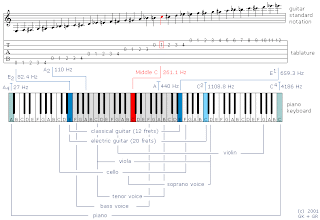
Ranges of musical instruments...

...not including the guitar boat tho.

Thursday, September 2, 2010

9/2 Scorch, MuseScore, SynthFont, Rock'n'B


I've already made a few posts about MIDI (maybe too many), but it's proven to be so educational for me I'll post one more time about it to note a few last tricks.

SCORCH
Appreciating B's music is greatly enhanced by following along with the score.  But if you're not accustomed to score-reading, it can be a bit tiring since it requires some concentration.  If you get lost, it can even get frustrating.  One way to get used to score-reading is to follow a MIDI score with a "Scorch" file, which is a web MIDI file which will play along to a scrolling standard score. Just install the Scorch plug-in (you may need to restart the computer even tho it doesn't ask you to) and check out the links below.
Look for this symbol for Scorch files:
When you hit the "play" button, the music will play through whatever MIDI synthesizer is built in to your soundcard and the score will indicate where the music is playing.  In large orchestral scores this makes life alot easier.
http://www.music-scores.com/beethoven/composer.php
http://www.mfiles.co.uk/sheet-music-classical.htm
http://8notes.com/beethoven.asp
http://www.sibeliusmusic.com/

MUSESCORE
Another way to see a MIDI score sroll with the music is by importing the MIDI file into a score notation program like Finale or Sibelius.  Those cost some "hard change", so an alternative I recommend is MuseScore, an open source program which is pretty similar.  It even comes with it's own MIDI synth.  Download MuseScore here.
After installing it, open a MIDI file.  When it asks you "Shortest note on import" choose 1/64. After a short wait it will import the MIDI file and create sheet music that goes with it.  When you play the MIDI file the sheet music will scroll along with it.  The music score won't look exactly like the published sheet music but in most cases it will be close enough that you can follow the music.  If there are too many notes then you can change the import "shortest note" to a higher value like 1/32.

SYNTHFONT
Now this is where it gets pretty cool.  Download a program called SynthFont.  With SynthFont you can load custom MIDI voices to go with your MIDI scores.  On the web there are many free "soundfonts" which are instrument sounds or groups of sounds for use in MIDI players.  Kind of like software ROM cards.  Instead of the cheap MIDI piano sound that came with your PC, you can get a near-studio quality soundfont which sounds pretty close to the real thing.  The way it works is easy once you get used to it.  Read the manual that comes with it.  It's well-written.

Below you can find soundfonts:
www.hammersound.com
soundfonts.darkesword.com
soundfonts.homemusician.net

Last week I posted an analysis of String Quartet Op. 131 M7 - here's my "rock" version using soundfonts - good for turning young people on to B perhaps?

Thursday, August 19, 2010

8/19 M.A.M. : Grosse Fugue Guitar Movie

I think of a Beethoven piece like a little journey.  Not very different from a movie of sorts, or a book.  That's one of the reasons I love Stephen Malinowski's Music Animation Machine (MAM Player).  Basically this is a piece of software which can play a MIDI file and produce a meaningful movie visualization of the music.  That iTunes/Windows Media visualizer?  Now obsolete.  I've been mesmerized by them sure, but ultimately they are completely useless when it comes to actually conveying any visual information with musical meaning.  The MAM player actually charts the movement and duration of MIDI pitches and durations in real-time.  It can also be set to visualize interval relationships and tonality!  Somewhat.  A (moving) picture is worth a thousand words so check out the Blogger video I made below...

In this video I loaded Bunji Hisamori's MIDI file of Piano Sonata 7 Mvment 1 into the MAM Player and set the display to "Part Motion BALLS".  I screen captured it using CamStudio but it's actually much smoother in its original form.  Anyways this animation looks like something that would result if Klee, Kandinsky and Beethoven got together to make a music video.  Each color represents a melodic line and each sphere represents the duration of a note.  There are about a dozen other display modes but this one is the most meaningful for me.
 
Grosse Fuge-ed Guitar Parts
OK now I combine the MIDI re-arranging abilities of Anvil Studio and the animation of the M.A.M. and you can get this bit of fun...("it might get loud")
(MIDI voices changed to 2 gtrs and 2 dbl basses)

MIDI sequenced by F. Sung,
Edited with Anvil Studio, CamStudio, Virtualdub, Adobe Audition


STRING QUARTET Op.133 "Grosse Fuge" (1826) 
("Guitar Version")


Listen to this 10 times in a row and you will either add 20 points to your IQ or go insane. Or perhaps both...

(Stephen Malinowski, the author of the MAM did a superb version with a real recording here.  No guitars though.)

Here's one more, to display the inverted color feature.  Not the best-sounding synth samples, sorry...
The Cello Sonata Opus 102.1, Mvment 4 (set to inverted colors)

Alternate Youtube Link

So here's this great free program where you can make your own instant Beethoven music videos!

Get MAM player here
Get MIDI files here. 

Also you may want to read my previous MIDI post which has many more MIDI links and info.