Showing posts with label Midi. Show all posts

Sunday, July 17, 2011

7/17 Beethoven's Symphonies and Overtures for Guitarists and Experimental Music Lovers

Picasso, "Woman with Mandolin" 1910
The symphonies of Beethoven are to me the greatest artistic creation in the history of mankind.  So of course it's pretty ambitious to transcribe these for rock instruments.  I resisted for a long while, but once I figured out a way to do the concertos, it was a natural next step.  The first couple symphonies took to a new instrumental arrangement relatively painlessly, but then things started getting sticky.  By the time I got to the 8th, the whole thing started sounding like avant-garde music from the future!  Taming the 9th was a journey in itself.  Nonetheless, here's the fruits of those labors, and I'm sure I'll come back to these again and again with "improvements"....

Symphony No.3 in E flat major, Op.55 'Eroica' (1805)


Symphony No.7 in A major, Op.92 (1811)


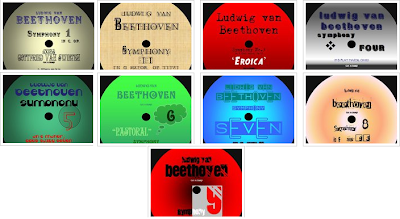
Click for the 9 Symphonies of Beethoven for Rock and Roll Addicts

Overtures here:

Saturday, July 16, 2011

7/16 The Compleat String Quartets for Guitarists and Experimental Music Lovers

I've posted about my sequenced "rock" transcriptions of Beethoven's string quartets a couple times before but this time I've gone back and remixed/remastered them a bit, with some simulated "turntable" visuals.  Basically I added more drums, reverb and compression.  They'll probably still drive any purists insane with cries of sacrilege, but for anybody with a background in rock and avant-garde music approaching my own, these might be entertaining and perhaps even illuminating.

While arranging/transcribing Beethoven's various types of music (quartets, concertos, symphonies, etc...) into these somewhat similar rock arrangements, I could more clearly see the different composing approaches he used between these genres.  The concertos seem the most straightforward from a melodic and structural standpoint, though the solo part gets all the "adventurous" stuff.  The quartets have the most complex and labyrinthine horizontal/melodic material, and the symphonies take a middle ground of having dense vertical constructions but simpler thematic material.  These are just gross generalizations of course...

String Quartet 10 in Eb, Op 74 "Harp" (1809)


String Quartet 11 in Fm, Op.95 "Serioso" (1811)


Full Quartets Below:
Early Quartets: Opus 18
Middle Quartets: Opus 59, 74, 95

Late Quartets: Opus 127, 130, 131, 132, 133, 135

Symphonies tomorrow....

Friday, July 15, 2011

7/15 The Weirdest Piano Concerto Arrangements You'll Love Vol.2

Remember when I posted the "The Weirdest Piano Concerto Arrangements You'll Love Vol.1"? Well here's Volume 2...hope you enjoy listening, these were a blast to put together!

Piano Concerto 1
I: 0:04 II: 12:29 III: 20:32

Link

Piano Concerto 2
I: 0:05 II: 13:15 III: 20:36

Link

Piano Concerto 4
I: 0:04 II: 16:44 III: 20:20

Link

Triple Concerto

Link

Next post is going to be delayed because I'm just BARELY keeping up in these last few mega-posts and Youtube just yanked my unlimited time-limit video rights for no apparent reason - which means I may have to redo a whole lot of already completed videos. Sad face.

Monday, July 11, 2011

7/11 Tchaikovsky's Beethoven

© All Rights Reserved by MikeBarnett

Having posted previously about composers "rewriting Beethoven" (Bartok, Rachmaninoff, Hindemith, Liszt), I submit Pyotr Ilyich Tchaikovsky to the list...courtesy of :
"One of his student orchestrations, Tchaikovsky scored Beethoven's famous violin sonata up to the end of the exposition of the first movement. There apparently is a recording of this on the Melodiya label, but I have not been able to acquire it yet. The current performance was made using the Garritan Personal Orchestra."
 
"Kreutzer" Violin Sonata (excerpt) (orch. Tchaikovsky) (1863-4): 
"Roll over Beethoven, And tell Tchaikovsky the news"
Created by .

Link

Monday, June 27, 2011

6/27 Bagatelles on Guitar, Hand Cannons

Though I have posted a good chunk of my own sequenced versions of Beethoven's works arranged/transcribed for guitar, there are of course many great live performances - among them this fine set of Bagatelles transcribed and performed by David Pavlovits.

3 Bagatelles:
From 11 Bagatelles, Op.119No. 4. Andante cantabile (@ 0:00)
From 11 Bagatelles, Op.119, No. 9. Vivace moderato (@ 1:36)
From 7 Bagatelles Op.33, No. 4. Andante (@ 2:21)


Link

What the heck, here's my arrangement of Wellington's Seige arranged for guitar. Adapted from Wellington's Victory, or the Battle of Vittoria op. 91, for Piano and Two Cannons, Hess 97..

(Shootin' starts at 2:45)

Modified and adapted from an original sequence by Mark S. Zimmer from The Unheard Beethoven.

Friday, June 24, 2011

6/24 Paganini's Caprices and Bartok's Mikrokosmos on Guitar

Nicolo Paganini, by Richard James Lane (died 1872), published 1831
Thought I'd divert from Beethoven today to post some of my guitar sequences of Paganini and Bartok...fun stuff (if I do say so myself).

Paganini - All 24 Solo Violin Caprices on Guitar

Linklist (1 hour)

Bartok on Guitar (and in various "rock-metal" arrangements)
  • Scherzo (Arr. for Guitar)
  • Allegro Barbaro (Rock Arrangement)
  • Mikrokosmos (27 selections arranged for solo Guitar)
  • Mikrokosmos 140 - Free Variations (arr. for Guitar & Drums)
  • Mikrokosmos 122, 146, 113, 147 (Arr. for Guitar & Drums)
  • 3 Piano Works (Arranged for guitar)
  • Mikrokosmos 149 - Burgarian Dance 2 (arr. for Guitar & Drums)
  • Mikrokosmos 148 - Bulgarian Dance 1 (Arr for Guitar & Drums)
  • Mikrokosmos 153 - Burgarian Dance 6 (arr. for Guitar & Drums)

Linklist (1 hour)

Tuesday, June 21, 2011

6/21 The Weirdest Piano Concerto Arrangements You'll Love Vol.1

“Guitar” (1914) ferrous sheet metal and wire" MoMA © 2011 Estate of Pablo Picasso
The Weirdest Piano Concerto Arrangements You'll Love Vol.1...or perhaps can "Like Eventually"...

After doing rock versions of Beethoven's complete string quartets, I decided that I wanted to hear how his concertos might sound if the lead instrument were a guitar instead of a piano or violin (or cello).  After a few fruitless attempts at incorporation guitar sounds into symphonic arrangements, I tried to do a guitar and synthesizer version.  Despite a good amount of work I finally had to admit that it just didn't sound that good.  Finally I realized that I should go back to my previous idea with the quartets and make full rock band arrangements for these works.  It took a bit more work since I didn't want to lose a single note, but I managed to get everything down to 2 electric guitars, bass and organ (as well as the lead instrument).

Here's Beethoven's Violin Concerto in a "Rock" arrangement.  Electric guitar replaces the violin solo, as well as the 1st violin part.
1 Allegro ma non troppo: from 0:03
2 Larghetto: from 22:03
3 Rondo. Allegro: from 29:18
Guitar Arrangement sequenced by Ed Chang using Synthfont.

Link

And here's Beethoven's 3rd Piano Concerto in a similar arrangement, with acoustic guitar as the soloist and electric guitars in the 1st and 2nd violin roles...
1. Allegro con brio: from 0:03
2. Largo: from 14:24
3. Rondo-Allegro: from 21:49
Guitar Arrangement sequenced by Ed Chang using Synthfont.

Link

Piano Concerto 5...the piano solo is divided into Left Hand -> Acoustic, Right Hand -> Electric
I: 0:03    II: 18:44   III: 25:15

Link

I did arrangements for all of B.'s concertos so I'll put up some more soon....

Friday, June 17, 2011

6/17 All New Beethoven Guitar Hits!

There's nothing more educational (for me, at least) than to post about Beethoven every single day - but a close second would arranging his works for guitar.  Taking a close look at each and every measure and tweaking them to fit in the context, range and style of a guitar is a bit of work - but quite rewarding.  A couple of my recent "experiments" are these two transcriptions: an arrangement of B.'s Symphony 3 "Eroica" 1st Movement (adapted from Franz Liszt's transcription for solo piano) and the Diabelli Variations (using a new guitar sound than my 2 previous versions).  As with my other guitar arrangements these sequenced realizations would  probably be extremely difficult (if not impossible) to play in real life without special tunings, etc...but they sound still pretty cool I think as "virtual extrapolations"...

Symphony 3 "Eroica" for 2 Guitars

Link

The Diabelli Variations for 2 Guitars

Link
Left Side Guitar - TOP                     Right Side Guitar = BOTTOM 
0:04 - Tema : Vivace
0:52 - Variation 1 : Alla marcia maestoso
2:22 - Variation 2 : Poco allegro
3:22 - Variation 3 : L'istesso tempo
4:15 - Variation 4 : Un poco piu vivace
5:03 - Variation 5 : Allegro vivace
5:52 - Variation 6 : Allegro ma non troppo e serioso
7:24 - Variation 7 : Un poco piu allegro
8:40 - Variation 8 : Poco vivace
9:47 - Variation 9 : Allegro pesante e risoluto
11:25 - Variation 10 : Presto
12:24 - Variation 11 : Allegretto
13:40 - Variation 12 : Un poco piu moto
14:45 - Variation 13 : Vivace
15:53 - Variation 14 : Grave e maestoso
19:46 - Variation 15 : Presto scherzando
20:34 - Variation 16 : Allegro
21:39 - Variation 17 : Allegro
22:45 - Variation 18 : Poco moderato
25:10 - Variation 19 : Presto
26:07 - Variation 20 : Andante
27:32 - Variation 21 : Allegro con brio - Meno allegro
28:50 - Variation 22 : Allegro molto ( alla 'Notte e giorno faticar' di Mozart)
29:36 - Variation 23 : Allegro assai
30:25 - Variation 24 : Fughetta ( Andante)
32:52 - Variation 25 : Allegro
33:37 - Variation 26 : Piacevole
34:21 - Variation 27 : Vivace
35:09 - Variation 28 : Allegro
36:11 - Variation 29 : Adagio ma non troppo
37:19 - Variation 30 : Andante, sempre cantabile
38:49 - Variation 31 : Largo, molto espressivo
42:28 - Variation 32 : Fuga (Allegro)
46:07 - Variation 33 : Tempo di minuetto moderato


This is my 3rd try at making a Diabelli Variations guitar recording, I think it's the final version...the previous two are OK but this one has the best guitar sound I think.  Previous versions:

Electric and Acoustic guitars: http://www.youtube.com/watch?v=o0RyJF5Uavo
Acoustic Guitars (1st version): http://www.youtube.com/watch?v=ZTg1GWIiX7w


However, for a live rendition of an arrangement of B.'s 5th Symphony I think this is the guy to beat:
Warning - very loud recording...

Beethoven 「運命」 LUNA KENZO

Wednesday, June 8, 2011

6/8 Beethoven's Homework: Correcting Mozart

As part of his compositional studies (which he continued his entire life) Beethoven would copy out works such as this one, Mozart's Fugue in C Minor, KV 426.  The interesting thing here is that he made some "corrections" - as well as some "mistakes".  The Unheard Beethoven site has a midi file of B.'s corrected/messed up version of Mozart's most difficult fugue -and so I rendered it in a "Beethoven 360" soundfont....

From The Unheard Beethoven's description:

Copy of Mozart's Fugue in C minor, KV.426, Hess 37 (Date of Beethoven's version unknown). Without any doubt, Mozart's Fugue in C minor for two pianos, KV.426, is one of the greatest fugues ever written since the death of J.S.Bach. A staggering amount of canonic devices is let loose on the fugue's main subject, while maintaining a remarkable clarity of texture, demonstrating Mozart's total control of counterpoint. At the same time the music is pervaded with a holy anger one expects of a Beethoven, rather than a Mozart. In short, Mozart combines in this unique masterpiece Bach's intellectual techniques with Beethoven's deep passion. It's therefore important to realize that Beethoven not only knew Mozart's fugue, but even made a copy of it in his own handwriting. We must assume he was impressed by this work. It's somewhat surprising that, as far as we know, Beethoven never attempted to compose a similar fugue himself. There are 36 minor deviations in the copy compared to Mozart's original, most of them mere slips of the pen. Yet there are also several improvements by Beethoven...

Link

Since today has a kind of "pedagogical" theme, here's Yvonne Lefébure teaching how to play Beethoven: (Piano Sonatas 31, 32 (Op. 110, 111))

Tuesday, June 7, 2011

6/7 The Elegiac Song (3 Versions)

Beethoven's Elegischer Gesang Op. 118 has the unusual instrumentation of chorus and string quartet.  Though it's more commonly performed with a a string orchestra these days, it was originally scored with a quartet in mind and the video below features just that.

Allmusic:
The Elegiac Song was composed during the summer of 1814 in memory of Eleanore von Pasqualati, the wife of Baron Johann (Beethoven's frequent and favorite landlord beginning in 1804), who had died in childbirth three years earlier. Her music-loving husband, the Empress Maria Theresia's physician, not only tolerated Beethoven's obsessive-compulsive changes of residence but made him feel a member of the family. We don't know who wrote the words, originally assigned to four singers and string quartet and later reworked for small chorus and string orchestra without double-basses. The music, which raises its voice only on the words "himmlischen Geistes," is indubitably the heartfelt product of its composer; its brevity alone is the reason we hear it so seldom in concert. 

(Actually Allmusic's info may be a bit out of date since I've read from other sources that Op.118 was still in sketch phase in 1814 and that modern scholars actually think the vocal group was originally for chorus, not 4 soloists.  The text was possibly written by Ignaz Franz von Castelli.)

Text:
Sanft, wie du lebtest, 
hast du vollendet, 
zu heilig für den Schmerz!
Kein Auge wein' ob 
des himmlischen Geistes Heimkehr.
Gently, as you lived,
have you died,
too holy for sorrow!
Let no eye shed tears
for the spirit's heavenly homecoming.

Elegischer Gesang Op. 118
Emory Mastersingers , Jonathan Arnold, conductor
VEGA String Quartet, 3/27/2011


Link

In keeping with the idea that no one is exactly sure what the instrumentation is supposed to be for this work I took the liberty of sequencing a version for guitar and winds (HERE), as well as a version for piano and winds (HERE).

Monday, June 6, 2011

6/6 The Other Symphony in C Minor

YOUNG BEETHOVEN (Lladró Porcelain Figures) 
One of my favorite finds on the Unheard Beethoven site is the early Symphony in C minor which Beethoven sketched but never completed.  Composed while still in Bonn, this sketch exists mainly as a piano score, but with markings for future orchestration.  In any case, it stands with the early Piano Quartet WoO. 36 as some of my favorite early Beethoven.  I have no idea why this is not more well known...

The Unheard Beethoven site features a midi version using full orchestration, completed by Willem, but I've never had much luck with full-symphony midi files.  So what I did here is to condense this completion back into piano score (in the video below), though I kept the timpani part.

Symphony Movement in C minor, Hess 298. (1791/93). orchestrated and completed
Midi Author: xickx
(The Unheard Beethoven)
"The Hess 298 sketch can be found in the Kafka Sketchbook, which is in the British Library. The heading reads: Sinfonia, and the tempo indication is Presto. It is in 3/4 time. The 111 bars long sketch is written on two staves, as if for piano. We have therefore not only the main melody, but also the bassline, which indicates unambiguously the intended harmonies. Once, in bar 91, there is an indication regarding the orchestration: obo[e]. Following this big chunk there are two little snippets, one 9 bars, the other 5 bars long. Clearly Beethoven intended to write a movement in Sonata form: the sketch covers the larger part of the expostion, with a first theme in C minor (bar 1), a transition (bar 68) and a second theme in the parallel key of E flat major (bar 86). The sketch breaks off halfway the second theme group.
"As is clear from the state in which Beethoven has left the sketch, it is impossible to complete this movement without the addition of extra material. A completion can therefore never claim to be authentic. It should be stressed that the aim of such a completion is to merely provide a framework which places the notes as written by Beethoven in an appropriate context, so that they can be judged and enjoyed as real music."

Willem's orchestrated version can be found here.  A midi of Beethoven's original sketch can be found here.

My reduction of Willem's orchestral arrangement to piano and timpani is below:

Link

Sunday, June 5, 2011

6/5 Lieder Redux 2 (More Clarinet and Guitar Arrangements)

Yesterday I featured my sequenced arrangements of some of Beethoven's song lieder in the form of guitar and clarinet duos.  This time I cover some of my favorite lieder without Opus numbers:

1. WoO 116 Que le temps me dure (How slowly time passes) 2 Versions

2. WoO 118 Seufzer eines Ungeliebten - Gegenlieb (Sigh of one who is unloved - Love returned)

3. Some Short Songs w/o Opus numbers:
  • WoO 125 La tiranna (The tyranny) (0:04)
  • Hess 133 Das Liebe Katzchen (The Dear Kitten) (2:30)
  • WoO 142 Der Bardengeist (The Bardic spirit) (2:56)
  • WoO 117 Der freie Mann (The free Man) (3:34)
4. WoO.131 Erlkoenig 

5. WoO 134 Sehnsucht (Longing)


Linklist

(Postcard images from http://www.lvbeethoven.com)

Saturday, June 4, 2011

6/4 Lieder Redux (Clarinet and Guitar Arrangements)

Recently I've been having some more fun with sequencing Beethoven compositions - this time rearranging vocal lieder from the original piano and voice instrumentation into guitar and clarinet duos.  Why?  The fact that I don't sing or play piano (tho I do play guitar and clarinet) may have something to do with it...Nonetheless I find these versions can provide additional appreciation for the melodies that Beethoven worked into the various texts he put to music.

Lieder Redux Playlist 1 (Works with Opus Numbers)
An Die Hoffnung Op.32
Adelaide, Op.46
6 Songs Op.48
  • - No.1 Bitten (Entreaty) (0:02)
  • - No.2 Die Liebe des Nachsten (Love of one's neighbor) (1:06)
  • - No.3 Vom Tode (Of Death) (1:53)
  • - No.4 Die Ehre Gottes aus de Natur (The Glory of God in nature) (3:59)
  • - No.5 Gottes Macht und Vorsehung (God's power and providence) (5:24)
  • - No.6 Busslied (Song of penance) (5:57)
8 Songs, Op.52
  • - No.1 Urians Reise um die Welt (Urian's voyage round the world) (0:02)
  • - No.2 Feuerfarb (The color of flame) (0:45)
  • - No.3 Das Liedchen von der Ruhe (The Little song about peace) (1:43)
  • - No.4 Maigesang (Maying Song) (2:36)
  • - No.5 Mollys Abschied (Molly's Departure) 4:38)
  • - No.6 Die Liebe (Love) (5:08)
  • - No.7 Marmotte (5:52)
  • - No.8 Das Blümchen Wunderhold (The Little flower wondrous fair) (6:24)
6 Songs Op.75
  • - No.1 Kennst du das Land (Do you know the land) (0:01)
  • - No.2 Neue Liebe, neues Leben (New love new life) (3:15)
  • - No.3 Aus Goethes Faust (Mephisto's Flohlied/Song of the flea) (6:09)
  • - No.4 Gretels Warnung (Gretel's warning) (8:05)
  • - No.5 An den fernen Geliebten (To the distant beloved) (9:25)
  • - No.6 Der Zufriedene (The Contented man) (10:20)
3 Songs, Op. 83
  • - 1. Wonne der Wehmut (Joy of Sadness) (0:01)
  • - 2. Sehnsucht (Longing) (2:08)
  • - 3. Mit einem gemalten Band (With a painted ribbon) (3:57)
Songs 1803-1822
  • -  Arietta Op.82, No.1 Hoffnung (1809) (Tell Me Dearest, That You Love Me..) (0:01)
  • - Op.84 Egmont: Clarchen's Song: 'Freudvoll und leidvoll' (1810) (Joy and Sorrow) (1:40)
  • - Op.88 Das Glück der Freundschaft (1803)(The Good Fortune of Friendship)(3:03)
  • - Op.99 Der Mann von Wort (1816)(A man of his word)(5:04)
  • - Op.100 Merkenstein (1816)(6:30)
  • - Op.128 Ariette (Der Kuss/The Kiss) (1822)(6:54)

Linklist

Monday, May 30, 2011

5/30 Orchestrated Pathetique

As readers of The Daily Beethoven should know by now, I'm a sucker for orchestral arrangements of chamber and solo works - and apparently Lenny Bernstein and Leopold Stokowski (among many others) also felt the same way.  So when I came across this string orchestra version of the Pathetique Sonata - well, I was delighted.  It's not uncommon to find alternate versions of the 2nd movement Adagio Cantabile, but this group does the 1st Movement Allegro Di Molto E Con Brio....

Beethoven's piano sonata "Pathetique" arranged for string orchestra by cellist, Leo Soeda. Cocoro Strings (formerly known as Kokolo Ensemble) is a conductorless string orchestra. This was our debut concert that took place at Judson Memorial Church in NYC on 8/30/07.

Link

Here's a version of the 3rd movement that is obviously sequenced and not live, but it's still interesting to hear someone (besides myself) create some original arrangements of B.'s works digitally....

Pathetique (Orchestral Version) - Beethoven

Sunday, May 29, 2011

5/29 Pianos, Cannons and the Gift of Fire

One of the best Beethoven-related sites around is the Unheard Beethoven site.  The people there have cataloged pretty much every Beethoven work not recorded (or seldom recorded) and posted midi files for B. fans to audition.  Midi files are more or less "piano rolls" of compositions and sometimes need a bit of finessing before they can sound musical.  So I took a few of these and did my best.... Here's the piano arrangement of Opus 43, "The Creatures of Prometheus" (Hess 90) authored by Willem.  I used my surround-piano sound ("Beethoven 360") for this...

From the Unheard Beethoven:
The Creatures of Prometheus op. 43, for Piano, Hess 90 (1801).
This transcription by Beethoven was published in 1801. The transcription quite faithfully follows the orchestral work, though with very different effects. Act One of the ballet--even including the overture--is much shorter than the second act. Act One concerns the creation of the first man and woman from dust by Prometheus; the second act concerns the education of these creatures. The theatre-bill for the first performance of March 28, 1801, describes the action as follows:  
"This allegorical ballet is based on the myth of Prometheus. The Greek philosophers, who knew of him, elucidate the story in the following manner--they depict Prometheus as a lofty spirit who, finding the human beings of his time in a state of ignorance, refined them through art and knowledge and gave them laws of right conduct. In accordance with this source, the ballet presents two animated statues who, by the power of harmony, are made susceptible to all the passions of human existence. Prometheus takes them to Parnassus, to receive instruction from Apollo, god of the arts, who commands Amphion, Arion and Orpheus to teach them music, Melpomene and Thalia tragedy and comedy. Terpsichore aids Pan who introduces them to the Pastoral Dance which he has invented, and from Bacchus they learn invented, and from Baccus they learn his invention, the Heroic Dance. The music is by Herr van Beethoven."
Link
More on The Creatures of Prometheus op. 43 in a previous post HERE.

Another piece I worked out is Wellington's Victory, or the Battle of Vittoria op. 91, for Piano and Two Cannons, Hess 97.  In this case I spruced up the cannons mostly - because I'm such a "cannon-expert" of course...(Midi Author: Mark S. Zimmer).
From the Unheard Beethoven:
Wellington's Victory, or the Battle of Vittoria op. 91, for Piano and Cannons, Hess 97 (1816)
This is certainly the strangest of Beethoven's arrangements for piano, since it also calls for two cannon to be fired throughout the first (Battle) portion of the piece. In this midi, the English forces are on the right channel; the French are on the left. As the battle progresses, the English march toward and take the center, forcing the French further left and eventually completely off the soundstage. The piece was wildly popular in its time as anti-Napoleonic feeling increased in Europe. This "symphony" (as Beethoven referred to it in letters) is easily the most clearly descriptive piece Beethoven ever wrote. The transcription ends, as does the orchestral version, with a fugato treatment of "God Save the King." Published 1816 by Steiner in Vienna.

Link

Monday, May 23, 2011

5/23 Beethoven's Finger Exercises

Rocking on the (Musical) Beach Chair
Beethoven's Opus 49 Piano Sonatas were first published in 1805 and are numbered Sonatas 19 and 20, but they were originally written in 1795 and 1796.  Apparently they were originally written as exercise sonatas ("light sonatas") for family and friends, but Beethoven's brother published them in order to generate inventory.  I've posted bits of these 2 sonatas before (19, 20), but there are a couple other "educational" pieces which are somewhat more mysterious - but still pretty charming.

Piano Exercise in B-flat major/minor, Hess 58
Piano Exercise in B-flat major/minor, Hess 58 (1792? 1800?). Published in Nottebohm, Beethoveniana II (1887) pp. 361-2.

Piano Exercise in C, Hess 59
Piano Exercise in C, Hess 59 (1800). Published in Nottebohm, Beethoveniana II (1887) pp. 361-2; Hess Supp. IX.

Original midi files from The Unheard Beethoven site.

Friday, April 1, 2011

4/1 Squeezed, Stretched and Webernized Beethoven

Well, being that today is April Fool's Day, I feel somewhat less inhibited than normal to post some of my more outlandish Beethoven "experiments"...

Last week, while working on my exotic percussion version of the 32 Variations in C minor WoO.80, I accidentally mapped the midi pitch data from the drum tracks to the guitar track, and when I replayed the sound file I thought...hmmmm, very "Webernian". Anyways, beyond the technical stuff, this is not "12-tone" in any way that is on purpose - it's just a bit of "chance-generated" fun and I'm pretty sure it would fool my mother if I told her it was by Webern...
An Atonal Variation on Beethoven's 32 Variations on an Original Theme
(Acoustic Guitar and Percussion Soundfonts)
Visuals by Malinowsky MAM Player

If Beethoven was Reborn as Webern

Another little oddity I put together is this ridiculously sped up version of the Moonlight Sonata.  I actually prefer the Moonlight Sonata to be played as slowly as possible, but increasing the speed to 1500 beats per minute and changing the sound to "guitar harmonics" yields something that might have come from the episode of Star Trek where the aliens were living at super-fast speed.
Moonlight Sonata at 1500 BPM on Guitar

Moonlight Sonata at 1500 BPM on Guitar

On the other end of the "time" spectrum is this version of the 9th Symphony.  A composer decided to digitally stretch out the 9th Symphony to the length of 24 hours.  The pitches all remain the same - but the durations of each note are lengthened proportionately so that the entire work (normally 75 minutes) is stretched to 24 hours. Here's a sampling, uploaded to Youtube by YT-er .

Duckieforever says: "The music is astounding, and ethreal, and beautiful. I just can't really say it any other way besides that. It's not like anything that I've ever heard in my life. But, for once, I think that after hearing the music rendered this way, I understand it more completly. It may not be what any of you enjoy, but I just ask that you open your minds, take a small breath, and relax."

A Total Beethoven Experience

For more on this work and accounts from attendees of a "performance" of this 24 hour version, check out the below link where you can find a Radiolab Radio podcast about it. (Direct mp3 link HERE)
Time - Radiolab

Friday, March 25, 2011

3/25 Beethoven on Exotic Percussion Instruments

African Slider Guiro - Ghana Shaker

Beethoven never visited the African continent or any other truly exotic tourist destinations in his lifetime, so he probably never heard any indigenous folk music from Egypt or India for example.  But if he had, I wonder if he would have incorporated some of these instruments into his work?  Since he was a big proponent of music technology and the first to use percussion as a primary motivic element (timpani in many symphonies/concertos and the "Turkish" interlude in the 9th Finale), I'm sure of it.  However, what I'm presenting today is probably nothing like what he might have composed.  It's still "from" Beethoven tho (in a sense).

I took a midi file of Beethoven's 32 Variations in C minor WoO.80 (1806) and mapped the notes to a soundfont comprised of exotic percussion samples. Though the pitches are no longer Beethoven's, the rhythms, dynamics and phrasing are still his. Still "classical music"?  Either way - I thought this came out pretty good...or at least fascinating.  (Visuals by Malinowsky MAM Player.)


Next, I took a midi file of Beethoven's "24 Variations on Righini's aria 'Venni Amore', WoO.65" (1791)
and arranged it for "junkyard percussion".  These are sounds recorded from pots, pans, powertools, and stuff you might find in a junkyard....the nature of these variation pieces lend themselves well to rhythmic transformations, I think.  By the way, these variations were originally dedicated to Countess Maria Anna Hortensia von Hatzfeld.  Somehow "The Hatzfeld Variations" has a nice ring to it.


These "arrangements" were alot of fun to create - I just hope this won't be known as the post where the Daily Beethoven "jumped the shark".
:)

Friday, March 18, 2011

3/18 If Beethoven Played a Toy Piano

About a month ago I posted Margaret Leng Tan's performance of the 1st movement of the Moonlight Sonata on toy pianos.  So when I recently came across some soundfonts for toy piano I "went to town" so to speak.  As regular readers are well aware, one of my favorite pasttimes is making music videos of Beethoven's works sequenced through midi and performed on alternate instrumentation.  So here is Beethoven's earliest published work (at age 12) - performed on the "RedGrand" toy piano sample set. It starts out a bit slow - but gets going soon enough...


9 Variations On A March Of Dressler, WoO.63 (1782) (Arr. for Toy Piano)
Toy Piano Arrangement by Ed Chang using Synthfont. / RedGrand
Original MIDI sequence for piano by Bunji Hisamori
Visuals from Stephen Malinowski's MAM Player


Link

And here's a live version performed on a harpsichord/cembalo - which sounds a little bit weird to me (and for me to say that it must mean something):
(Wilhelm Krumbach, Cembalo)

Link

The original version for piano can be found HERE.

(I also did a version of this piece for acoustic guitar here: 9/24 If Beethoven Played Guitar V1)

Thursday, March 10, 2011

3/10 String Quartet Op.133 "Grosse Fuge" (Color Analysis and Rock Arr.)

Yesterday was the color chart/video of Opus 130, and since the Grosse Fugue was originally the grand finale of Opus 130 it seems necessary to put up Mr. Rich's color breakdown of this crazy and fun behemoth.  I think this is like the 2nd or 3rd analysis of the G.F. I've posted, but this one is pretty much all from Alan Rich's book, "Play by Play".  Personally I like my own analysis better, his is a little too simplified for my tastes, but I learned alot from his....

String Quartet Op.133 "Grosse Fuge" (1826)
Guarneri Quartet


Overture (MAROON)
1st Theme
2nd Theme
3rd Theme
4th Theme

Part I: fugue (based on 4th Theme): (BROWN)
Entrance 1
Entrance 2
Entrance 3
Entrance 4
Exposition (partial)
Variations on subject
Exposition (partial)
Exposition (variations on subject)

Part II: (BLUE)
3rd Theme (return)
3rd Theme (several fugue-like entrances)
3rd Theme (fragments)
3rd Theme (variation)

Part III: (VIOLET)
2nd Theme (return)
2nd Theme: fugue
2nd Theme: fugue (abridged)
2nd Theme (variation)
2nd Theme (further variation)

Part IV: (SEA GREEN)
3rd Theme (return)
Transition

Part V: (DARK BLUE)
2nd Theme (return)
2nd Theme (development)
1st Theme (return)

Part VI: fugue (based on part I) (OLIVE)
1st Theme (return)
Part I (variation)

(form breakdowns from Alan Rich's "Play by Play")

Rock Arrangement: